Two-Tailed Mermaids
Historically, people likely believed that mermaids, including two-tailed mermaids (a.k.a. Sirena bicodula, gorgons), actually existed in the distant reaches of the Earth. When rumors of these creatures circulated, they were described in many and various ways. In this hub, I discuss various depictions of mermaids with two tales in bestiaries, mythology, and art.
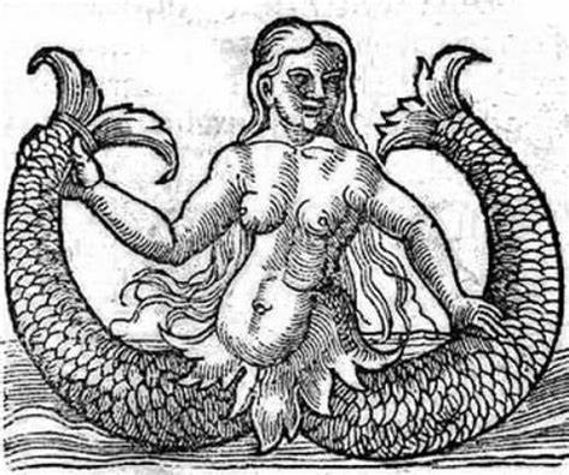
from 'Naturalis Historia' (1565)
Sirens
The siren daughters of Phorcus or Achelous were said to live on an island surrounded by crags and rocks. They used their beautiful singing voices to lure sailors to their deaths. The sirens were described in various ways, as having the bodies of birds or beasts. Some depictions of them show them as double-tailed mermaids (see statue of Mixoparthenos, below).
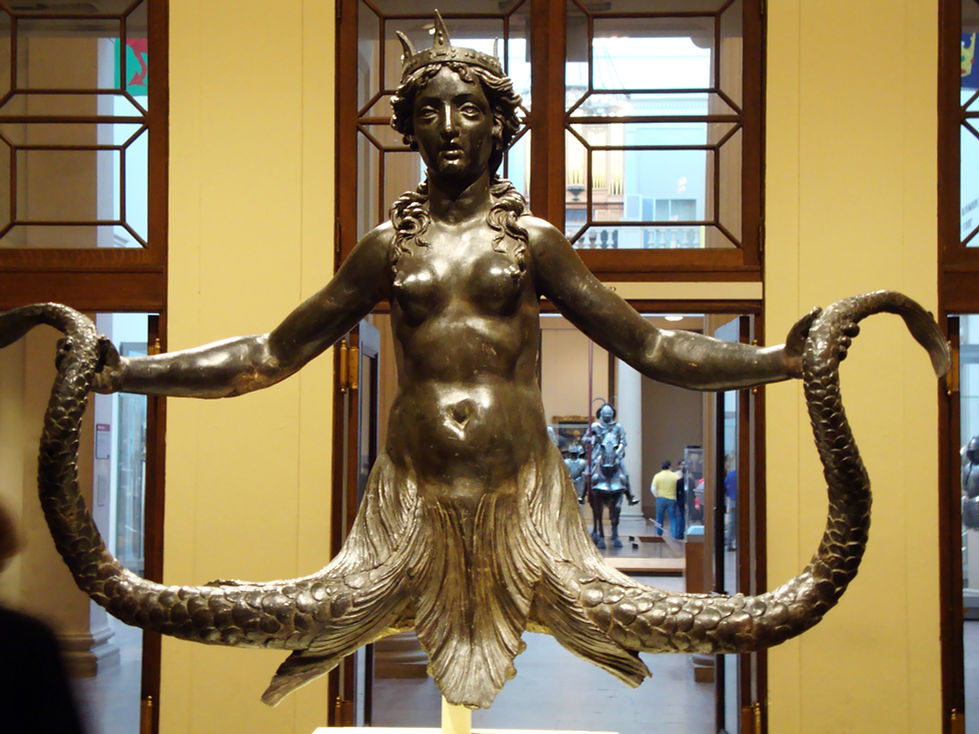
16th century bronze of Mixoparthenos the siren
Melusine
A.k.a. Melusina, Mixoparthenos, Scylla, Gorgona
A melusine is a creature similar to a mermaid (or siren) but depicted as living in freshwater. It is often shown as twin-tailed. The concept of the melusine comes from French and other European myths and appears in heraldry. The Melusine is a maiden who transforms partly into a siren in water. Most myths about Melusine are similar to the tale of the Duke of Aquitaine, who married a girl who required that he never bother her on Saturdays. When he broke this promise, he saw her in her siren form, and she turned into a dragon and fled, never to return.
The melusine has been a popular motif in decorative and textile arts for centuries. Their symmetry lends itself well to many uses, including the embroidered panels on traditional dresses and architectural features, especially fountains.
-
Alchemical Melusine: In alchemy, the melusine represents enlightenment. The two tails of the siren represent symbolic dualities such as water and earth, or body and soul.
-
Lusignan Melusine: The French Lusignan family claims descent from a Melusine.
-
Naples Melusine: The melusine is associated with Naples and used to appear in its heraldry.
Gorgona
In modern Greek langage the two-tailed mermain is referred to as grogona. They are most often considered evil creatures and seductresses. Gorgona appear often in Cretan traditional embroidery.
Starbucks
The Mermaid Starbucks logo was created in 1971 by Teri Heckler. The symbolism was reportedly intended to link the seductive nature of the mermaid to the allure of good coffee.
References
-
Krody, S. B. (2004). The Tale of the Two-Tailed Mermaid A Case Study in the Origins of the Cretan Embroidery Style.
-
Maxwell, M. (2024). The Little Encyclopedia of Mermaids: An A-to-Z Guide to Mystical Sea Creatures. Running Press Adult.
-
Phillips, M., & Rippin, A. (2010). Howard and the mermaid: Abjection and the Starbucks’ Foundation memoir. Organization, 17(4), 481-499.
-
Zhou, Q. (2024). The Impact and Investigation of Starbucks’ Profit Generation Strategies. In SHS Web of Conferences (Vol. 185, p. 03020). EDP Sciences.